E-Commerce
E-Commerce Software Development
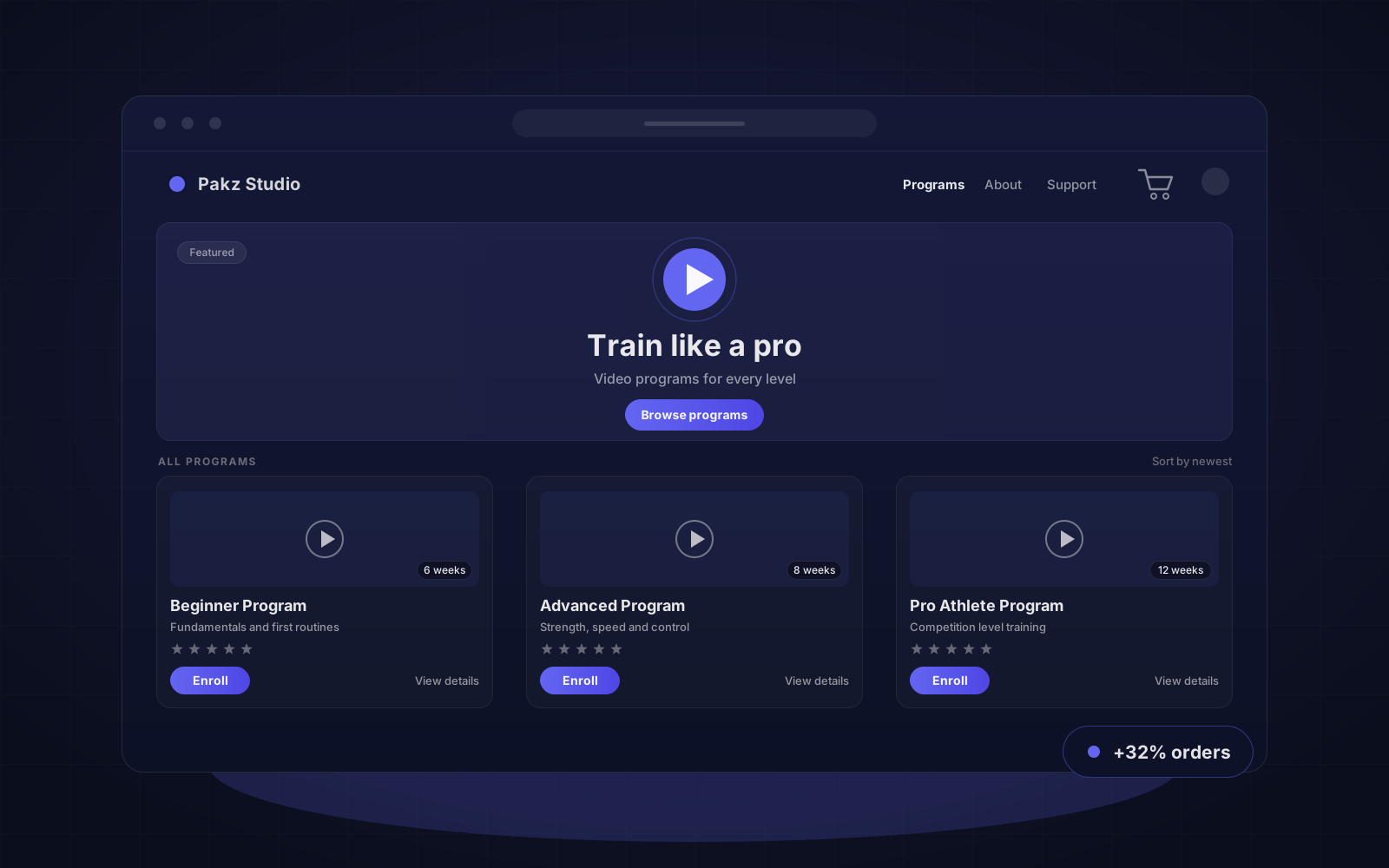
We build products and then keep running them, so we price a storefront by what it costs after launch, not at handoff. Pakz Studio came to us needing a from-scratch platform for video training programs: product configurator, secure checkout, course-access portal, live in two months, orders up 32%. If you are weighing a custom build against another year of stacking apps on a template, that is the conversation we have most weeks.
The problem
Where e-commerce teams get stuck.
The app stack quietly became the platform
Ten subscriptions, ten sync jobs, and at least one that fails silently every week. A stack of apps assembled to approximate what a single integration layer would do natively adds up faster than anyone budgeted for, and every app boundary is a place where inventory, pricing, or order data drifts apart.
The reliable tell: your team has started describing workarounds instead of features, and nobody can say with confidence which system holds the true stock number.
Replatforming gets planned as a launch, not a migration
The big bang rewrite is still the most common way a replatforming project goes wrong: everything rebuilt in parallel, cut over on one date, historical orders and SEO URLs handled last. Migrations that survive move component by component, with the old system live until each piece is validated in production.
Timing matters as much as method. Starting a commerce migration in October when the business peaks in November is a self-inflicted wound, and data migration is where the schedule usually breaks.
Product data is nowhere near passport ready
Most catalogs carry a fraction of the attributes a passport requires, and the ones they do carry were written for a product page rather than for a regulator. An EU Digital Product Passport asks for structured, category-specific data with traceable provenance and a scannable carrier on the physical item.
Most of that gap is supplier engagement rather than engineering: material composition, country-of-origin granularity, certificates, test reports. Brands that start once the delegated act lands negotiate with suppliers from the weakest possible position.
A checkout that cannot survive an audit
The European Accessibility Act reaches the entire purchase flow for EU consumers: product information, cart, payment, confirmation, and support. A separate simplified page does not satisfy it, and the obligation is continuous rather than a one-time certification.
Storefronts usually fail on the parts nobody demos: keyboard-only checkout, focus order inside modals, error messages bound to the field that caused them, and embedded payment widgets that were never audited because they belong to a vendor.
What we build
How we solve it.
Compliance
The rules that shape the build.
EU Digital Product Passport (ESPR, Regulation (EU) 2024/1781)
The Ecodesign for Sustainable Products Regulation makes the Digital Product Passport the way sustainability and compliance data travels with a product. The European Commission describes it as a digital container linked to the item by a QR code, registered before the product is placed on the EU market, and registered at customs for imports.
The EU-level DPP Registry went live on 20 July 2026 with a testing environment alongside it. The first hard deadline is 18 February 2027 for certain large batteries. Textiles, aluminium, tyres, furniture, and further ecodesign groups follow on their own delegated acts.
What that means in the build: a versioned schema per product category, an ID resolver fast enough for a consumer scan anywhere in the world, role-based access so a shopper, a recycler, and a regulator see different fields, and a composer service that assembles the record from PIM, ERP, PLM, and supplier portals with provenance retained.
European Accessibility Act (Directive (EU) 2019/882)
The European Commission lists e-commerce among the services the Act covers, and the national provisions apply after 28 June 2025. It reaches any provider concluding consumer contracts in the EU, wherever the company is registered.
The working technical benchmark is EN 301 549, which carries WCAG at level AA inside it, and the harmonised standards are still being updated toward WCAG 2.2. Compliance is not a certificate: you publish an accessibility statement, keep procedures that maintain conformity as the site changes, and cooperate with national enforcement authorities.
The cheapest time to do this work is while the checkout is being designed. Retrofitting a live purchase flow after a complaint costs several times more and lands on the worst possible schedule.
General Product Safety Regulation (EU) 2023/988
The GPSR has applied since 13 December 2024, covers products sold online including used, repaired, and reconditioned goods, and requires a responsible economic operator established in the EU for each product.
Article 19 pushes compliance onto the product page itself. A distance-selling offer must clearly show the manufacturer name plus postal and electronic address, information identifying the product including a picture and type, and warnings or safety information in a language consumers understand. Burying it in terms and conditions does not count.
Marketplace operators carry more. Per EU-OSHA, providers register on Safety Gate, designate a single contact point, run internal product safety processes, and must notify affected buyers and remove or disable unsafe listings on order from a market surveillance authority. That is a data model and a workflow, not a policy page.
Cross-border duty and VAT: the end of the EUR 150 relief
The Council agreed to remove the EUR 150 customs duty relief for e-commerce parcels, with a simple temporary method for calculating duties running until the EU Customs Data Hub provides that functionality from mid-2028.
For a storefront this is engineering, not a finance ticket. Landed cost shown before payment, duty and VAT rules per destination, IOSS handling, returns and refunds that reverse duty correctly, and invoice records that survive an audit all live in code and in the order state machine.
This is also the requirement that most often exposes a platform ceiling. Multi-country pricing, currency, warehouse, and duty logic is exactly what a monolithic template struggles to express, and it is a common trigger for moving to a composable stack.
Proof
Products we have shipped.
Related reading


FAQ
Common questions.
Let's talk
Bring us the storefront problem you keep postponing.
A free 30-minute call with the people who would build it. Bring your platform costs, your integration list, and your compliance deadlines, and you will leave with an honest read on build versus buy, a rough range, and a phased plan. If Shopify is the right answer, we will say so.
Book a Free Consultation